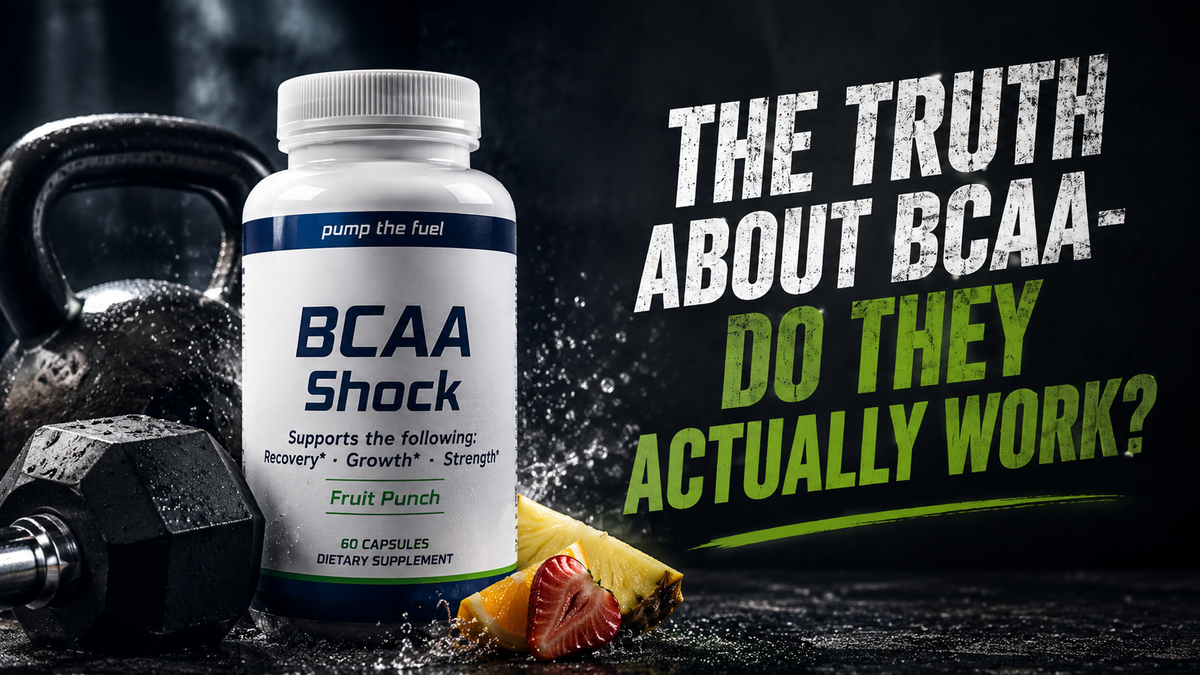
BCAAs are everywhere. Pre-workout shakes, intra-workout sippers, post-workout recovery drinks. The supplement industry sells billions of dollars of branched-chain amino acids every year on one promise: they help you recover faster, build more muscle, and train harder.
The science tells a more complicated story. Here's what BCAAs actually do, when they help, and when they're a waste of money.
What Are BCAAs, Exactly?
Branched-chain amino acids are three of the nine essential amino acids your body can't produce on its own: leucine, isoleucine, and valine. They make up roughly 35% of the amino acids in muscle tissue.
Leucine is the star of the show. It's the primary trigger for muscle protein synthesis (MPS) — the process that builds and repairs muscle. Most BCAA supplements are formulated at a 2:1:1 ratio (twice as much leucine as the other two) because of this.
Do BCAAs Actually Build Muscle?
Here's the awkward truth: BCAAs alone don't build muscle effectively.
A landmark 2017 study in the Frontiers in Physiology journal showed that BCAAs taken in isolation produced about 22% less muscle protein synthesis than a full essential amino acid (EAA) profile. Why? Because building muscle requires all nine essential amino acids — not just three.
Think of it like building a house. You can't build it with three types of bricks while missing the other six. Your body needs the full toolkit.
If your diet already includes enough quality protein — and it should — your body already has all the BCAAs it needs to maximize muscle growth.
So Are BCAAs Useless?
Not entirely. Research does show legitimate benefits in specific scenarios:
1. Reducing Muscle Soreness
Multiple studies — including a 2017 meta-analysis in the Nutrition Journal — found that BCAAs taken before and during training can reduce delayed onset muscle soreness (DOMS) by 20–30% in some lifters. Not life-changing, but noticeable.
2. Fighting Fatigue During Long Sessions
BCAAs compete with tryptophan for entry into the brain. Lower tryptophan = lower serotonin = less perceived fatigue. This is most useful during long endurance sessions (60+ minutes) or fasted training.
3. Preserving Muscle in a Deep Calorie Deficit
If you're cutting hard and training fasted, BCAAs can offer some protection against muscle breakdown. The keyword is some. EAAs do this job better.
When BCAAs Are a Waste of Money
- You hit your daily protein target. If you're eating 1.6+ g/kg of complete protein, you're already getting plenty of BCAAs. Adding more does nothing.
- You drink a whey protein shake. A standard scoop of whey contains roughly 5–6 grams of BCAAs naturally. That's more than most BCAA supplements deliver per serving.
- You're not training fasted. If you eat 1–2 hours before your workout, the meal already covers what BCAAs would provide.
- You eat a balanced diet. Chicken, eggs, dairy, fish, beans — all packed with BCAAs. You're not deficient.
When BCAAs Actually Make Sense
- You train fasted (early morning before food) and want to protect against muscle breakdown.
- You're in a long cutting phase with low overall protein intake.
- You do long endurance sessions (running, cycling, swimming over an hour).
- You like the flavored hydration during workouts and want a low-calorie alternative to sugary sports drinks.
That last one matters more than people admit. A flavored BCAA drink during a hard session helps you hit your hydration goals and adds a small mental boost. Even if the muscle-building effect is minimal, the behavioral effect (you actually drink water during workouts) is real.
EAAs vs BCAAs: The Smarter Upgrade
If you're going to spend money on amino acid supplementation, Essential Amino Acids (EAAs) are the better choice. EAAs contain all nine essential amino acids — including the three BCAAs — so you get everything you need for muscle protein synthesis in one product.
Studies consistently show EAAs outperform BCAAs in nearly every metric: muscle protein synthesis, recovery, lean mass retention. The price difference is minor. The performance difference isn't.
What to Look For in a BCAA Product
If you've decided BCAAs fit your training style, here's what matters:
- 2:1:1 ratio of leucine to isoleucine to valine. Anything more extreme (10:1:1 or higher) is marketing nonsense.
- Minimum 5g per serving with at least 2.5g of leucine.
- No "proprietary blends." If a label hides the individual amounts behind a single combined number, walk away. You're being upcharged for the privilege of not knowing what you're drinking.
- Third-party testing. Look for NSF Certified, Informed Sport, or similar verification. The supplement industry has a tainted product problem.
- Clean ingredients. Skip the artificial colors and sucralose-heavy formulas if you can. Steviol glycosides or monk fruit are cleaner sweetener choices.
The Bottom Line
BCAAs aren't a scam — but they aren't a magic muscle builder either. For most lifters who eat enough quality protein, they're an unnecessary expense. For specific situations — fasted training, long endurance sessions, deep cuts — they can offer modest benefits.
Before you buy BCAAs, ask yourself: Am I hitting my daily protein target consistently? If the answer is no, fix that first. A bag of chicken breasts will do more for your gains than a tub of BCAAs ever will.
If the answer is yes — and you still want the intra-workout hydration boost or you train fasted — then BCAAs become a reasonable add-on. Just don't expect miracles.
Looking for clean, lab-tested supplements with transparent dosing? Check out our full lineup — no proprietary blends, no shortcuts.