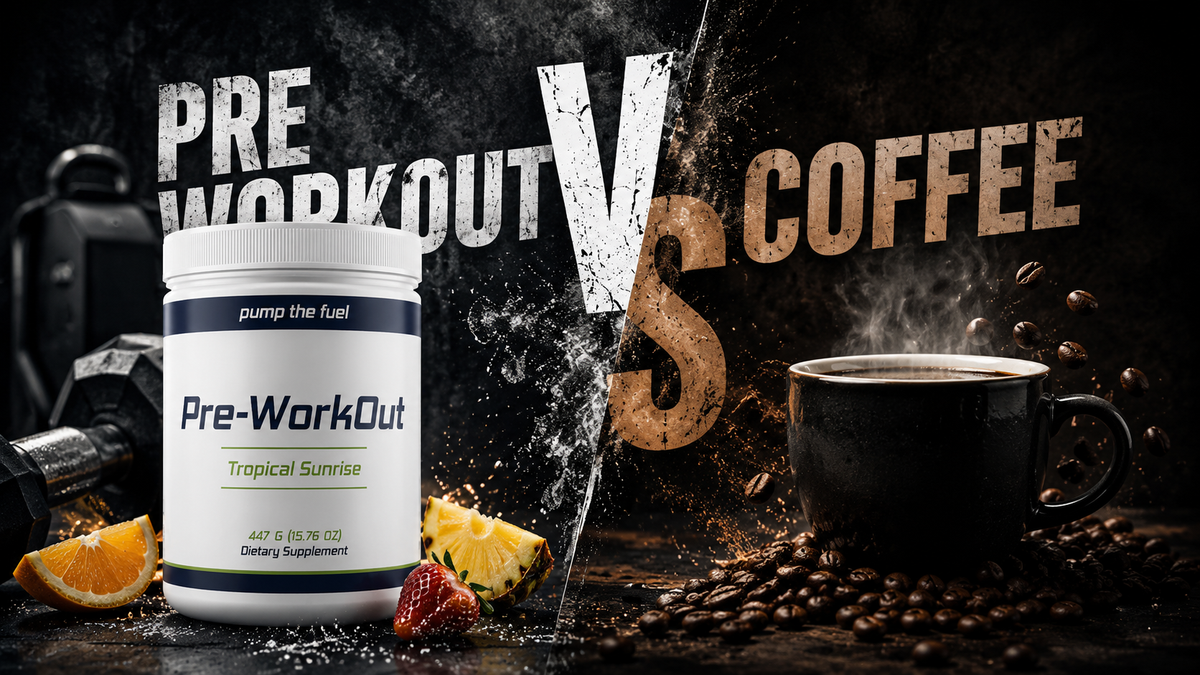
<p>Every morning, millions of lifters face the same question: scoop of pre-workout, or a strong cup of coffee?</p>
<p>Both deliver caffeine. Both promise energy, focus, and a better session. One costs about 50 cents per workout. The other costs $2.50 or more. So which one actually delivers more performance — and where does the real difference lie?</p>
<p>Here's the honest breakdown, ingredient by ingredient.</p>
<h2>The Common Ground: Caffeine</h2>
<p>Caffeine is the engine behind both options. It's also the most researched legal performance enhancer on the planet — with over <strong>500 peer-reviewed studies</strong> confirming its benefits for strength, endurance, focus, and rate of perceived exertion.</p>
<p>The effective dose for performance is <strong>3 to 6 mg per kilogram of bodyweight</strong>. For a 180 lb (82 kg) lifter, that's roughly 250–500 mg per session.</p>
<ul>
<li><strong>One cup of black coffee:</strong> 80–120 mg caffeine</li>
<li><strong>One scoop of pre-workout:</strong> 150–350 mg caffeine</li>
<li><strong>Cold brew (12 oz):</strong> 200–300 mg caffeine</li>
</ul>
<p>If you're going caffeine-only, you'd need 2–3 cups of regular coffee or one strong cold brew to match the dose in a single pre-workout scoop. That alone changes the math.</p>
<h2>What Pre-Workout Has That Coffee Doesn't</h2>
<p>Pre-workout supplements aren't just caffeine pills. A well-formulated pre stacks multiple proven ingredients that coffee can't touch. Here's what's actually in them and what each one does.</p>
<h3>1. Beta-Alanine (3.2–6.4 g)</h3>
<p>That tingling sensation on your face and neck? That's beta-alanine. Beyond the harmless skin tingle, it buffers lactic acid buildup in your muscles, letting you push more reps before failure. Meta-analyses show <strong>2–4% improvements in muscular endurance</strong> — modest sounding, but huge over hundreds of training sessions.</p>
<h3>2. Citrulline Malate (6–8 g)</h3>
<p>This is the "pump" ingredient. Citrulline increases nitric oxide production, which widens blood vessels and improves blood flow to working muscles. The result: better pumps, more nutrient delivery, less fatigue. A 2010 study showed a <strong>52% increase in bench press reps</strong> when subjects took 8g of citrulline pre-workout.</p>
<h3>3. Creatine Monohydrate (3–5 g)</h3>
<p>The most studied performance supplement after caffeine. Increases ATP availability, the primary energy currency for explosive movement. Boosts strength, power, and muscle volume. Coffee has zero creatine. Most pre-workouts include it.</p>
<h3>4. L-Tyrosine or L-Theanine (1–2 g)</h3>
<p>Focus amplifiers. Tyrosine supports dopamine production for mental drive. L-theanine smooths out caffeine's jitters and improves focus. Coffee has neither (though green tea has a small amount of theanine).</p>
<h3>5. Electrolytes</h3>
<p>Most quality pres include sodium, potassium, and magnesium to support hydration and prevent cramping. Coffee actually mildly <em>depletes</em> electrolytes through its diuretic effect.</p>
<h2>What Coffee Has That Pre-Workout Doesn't</h2>
<p>Coffee isn't just a delivery vehicle for caffeine. It has real advantages.</p>
<h3>1. Antioxidants</h3>
<p>Coffee is one of the richest dietary sources of polyphenols and chlorogenic acid. These compounds support cardiovascular health, reduce inflammation, and have been linked to lower risk of Type 2 diabetes, Parkinson's, and several cancers. Pre-workouts don't deliver this.</p>
<h3>2. Lower Cost (Long Term)</h3>
<p>A bag of decent ground coffee is about $12 and lasts a month. That's $0.40 per cup. A premium pre-workout tub is $40–60 for 20–30 servings. Coffee wins here by a wide margin.</p>
<h3>3. Better Gut Tolerance</h3>
<p>Some lifters get GI distress from pre-workout's stacked ingredients (especially beta-alanine, niacin, or high caffeine doses). Coffee — for habitual drinkers — is gentler on most stomachs.</p>
<h3>4. No Risk of Tainted Product</h3>
<p>The supplement industry has a long history of undeclared ingredients and contamination. Coffee is just coffee. If you're an athlete subject to drug testing, this matters.</p>
<h2>Head-to-Head: When Each Wins</h2>
<h3>Coffee Wins When:</h3>
<ul>
<li>You train moderately (3–4 days a week) and don't push to failure</li>
<li>You're sensitive to stimulants or get the jitters easily</li>
<li>You're on a strict supplement budget</li>
<li>You're a competitive athlete worried about banned substances</li>
<li>You're training in the morning and want a calmer, slower ramp into your session</li>
</ul>
<h3>Pre-Workout Wins When:</h3>
<ul>
<li>You're training heavy and want every ounce of strength, pump, and endurance</li>
<li>You're in a cutting phase and need extra focus despite low energy</li>
<li>You do long, demanding sessions (60+ minutes)</li>
<li>You want the beta-alanine endurance boost coffee can't provide</li>
<li>You're stacking it with creatine and citrulline anyway — bundling them in one scoop is convenient</li>
</ul>
<h2>The Smart Hybrid Approach</h2>
<p>Here's what serious lifters often do: use both, but cycle them.</p>
<ul>
<li><strong>Heavy training days:</strong> Pre-workout for max output</li>
<li><strong>Light or accessory days:</strong> Black coffee to keep stimulant tolerance low</li>
<li><strong>Deload weeks:</strong> Coffee only, or no caffeine at all</li>
</ul>
<p>This approach gets you the performance benefit of a real pre-workout when you need it, while preventing the tolerance buildup that makes caffeine stop working. Most regular pre-workout users find their scoop loses punch after 3–4 weeks of daily use. Cycling fixes that.</p>
<h2>What to Avoid in a Pre-Workout</h2>
<p>Not all pre-workouts are equal. Here's what to watch for:</p>
<ul>
<li><strong>Proprietary blends.</strong> If a label says "5,000 mg Energy Matrix" instead of listing exact ingredient doses, walk away. You're being scammed.</li>
<li><strong>Caffeine over 400 mg per scoop.</strong> This is borderline reckless for most people. You can't dose-adjust either.</li>
<li><strong>DMAA, DMHA, or unverified stimulants.</strong> Banned by most sporting bodies and the FDA. Real risks.</li>
<li><strong>Massive artificial color and flavor loads.</strong> If your scoop is fluorescent blue, that's not a strength gain.</li>
</ul>
<h2>The Bottom Line</h2>
<p>Coffee is excellent. Cheap, healthy, effective. If you're a casual lifter, it's all you need.</p>
<p>Pre-workout is a real performance tool — not because it has caffeine, but because it stacks beta-alanine, citrulline, creatine, and focus enhancers in one dose. If you train seriously and want a measurable edge on heavy days, a quality pre delivers.</p>
<p>Don't pick one religiously. Use both. Coffee for casual days, pre for the days you're chasing a PR.</p>
<p><em>Want a transparent, third-party tested pre-workout with no proprietary blends? Browse our <a href="/collections/all">supplement lineup</a> — clean ingredients, real doses, honest labels.</em></p>